

Health Library
Normal pressure hydrocephalus
Hydrocephalus - occult; Hydrocephalus - idiopathic; Hydrocephalus - adult; Hydrocephalus - communicating; Dementia - hydrocephalus; NPH
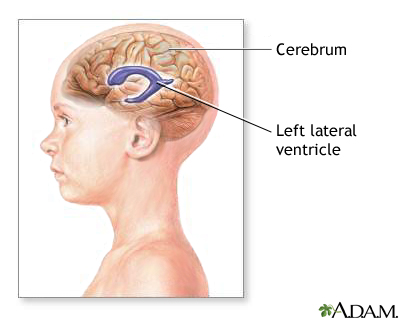
Hydrocephalus is a buildup of spinal fluid inside the fluid-filled chambers of the brain. Hydrocephalus means "water on the brain."
Normal pressure hydrocephalus (NPH) is a rise in the amount of cerebrospinal fluid (CSF) in the brain that affects brain function. However, the pressure of the fluid is usually normal.
Images
I Would Like to Learn About:
Causes
There is no known cause for NPH. But the chance of developing NPH is increased in someone who previously had any of the following:
- Bleeding from a blood vessel or aneurysm in the brain (subarachnoid hemorrhage)
- Certain head injuries
- Meningitis or similar infections
- Surgery on the brain (craniotomy)
As CSF builds up in the brain, the fluid-filled chambers (ventricles) of the brain swell. This causes pressure on brain tissue. This can damage or destroy parts of the brain.
Symptoms
Symptoms of NPH often begin slowly. There are three main symptoms of NPH:
- Changes in the way a person walks: difficulty when beginning to walk (gait apraxia), feeling as if your feet are stuck to the ground (magnetic gait)
- Slowing of mental function: forgetfulness, difficulty paying attention, apathy or no mood
- Problems controlling urine (urinary incontinence), and sometimes controlling stools (bowel incontinence)
The diagnosis of NPH can be made if any of the above symptoms occur and NPH is suspected and testing is done.
Exams and Tests
Your health care provider will perform a physical exam and ask about your symptoms. If you have NPH, your provider will likely find that your walking (gait) is not normal. You may also have memory problems.
Tests that may be done include:
- Head CT scan or MRI of the head
- Lumbar puncture (spinal tap) with careful testing of walking before and right after the spinal tap
Treatment
Treatment for NPH usually requires surgery to place a tube called a shunt that routes the excess CSF out of the brain ventricles and into the abdomen. This is called a ventriculoperitoneal shunt.
Outlook (Prognosis)
Without treatment, symptoms often get worse and could lead to death.
Surgery improves symptoms in some people. Those with mild symptoms have the best outcome. Walking is the symptom most likely to improve.
Possible Complications
Problems that may result from NPH or its treatment include:
- Complications of surgery (infection, bleeding, shunt that does not work well)
- Loss of brain function (dementia) that becomes worse over time
- Injury from falls
- Shortened life span
When to Contact a Medical Professional
Contact your provider if:
- You or a loved one is having increasing problems with memory, walking, or urine incontinence.
- A person with NPH worsens to the point where you are unable to care for the person yourself.
Go to the emergency room or call 911 or the local emergency number if a sudden change in mental status occurs. This may mean that another disorder has developed.
Related Information
DementiaHydrocephalus
Cerebrospinal fluid (CSF) collection
Brain surgery
Meningitis
Subarachnoid hemorrhage
Ventriculoperitoneal shunt - discharge
References
Frim DM, Vivas-Buitrago T, Rigamonti D, Lacy M. Surgical management of hydrocephalus in the adult. In: Quiñones-Hinojosa A, ed. Schmidek and Sweet: Operative Neurosurgical Techniques. 7th ed. Philadelphia, PA: Elsevier; 2022:chap 81.
Knopman DS. Cognitive impairment and dementia. In: Goldman L, Cooney KA, eds. Goldman-Cecil Medicine. 27th ed. Philadelphia, PA: Elsevier; 2024:chap 371.
Rosenberg GA. Brain edema and disorders of cerebrospinal fluid circulation. In: Jankovic J, Mazziotta JC, Pomeroy SL, Newman NJ, eds. Bradley and Daroff's Neurology in Clinical Practice. 8th ed. Philadelphia, PA: Elsevier; 2022:chap 88.
Sader N, Hamilton MG, Riva-Cambrin J. The role of endoscopic third ventriculostomy: a critical review. In: Winn HR, ed. Youmans and Winn Neurological Surgery. 8th ed. Philadelphia, PA: Elsevier; 2023:chap 45.
BACK TO TOPReview Date: 1/27/2026
Reviewed By: Joseph V. Campellone, MD, Department of Neurology, Cooper Medical School at Rowan University, Camden, NJ. Review provided by VeriMed Healthcare Network. Also reviewed by David C. Dugdale, MD, Medical Director, Brenda Conaway, Editorial Director, and the A.D.A.M. Editorial team.
 | A.D.A.M., Inc. is accredited by URAC, for Health Content Provider (www.urac.org). URAC's accreditation program is an independent audit to verify that A.D.A.M. follows rigorous standards of quality and accountability. A.D.A.M. is among the first to achieve this important distinction for online health information and services. Learn more about A.D.A.M.'s editorial policy, editorial process and privacy policy. A.D.A.M. is also a founding member of Hi-Ethics. This site complies with the HONcode standard for trustworthy health information: verify here. |
The information provided herein should not be used during any medical emergency or for the diagnosis or treatment of any medical condition. A licensed medical professional should be consulted for diagnosis and treatment of any and all medical conditions. Links to other sites are provided for information only -- they do not constitute endorsements of those other sites. No warranty of any kind, either expressed or implied, is made as to the accuracy, reliability, timeliness, or correctness of any translations made by a third-party service of the information provided herein into any other language.
© 1997-
2026 A.D.A.M., a business unit of Ebix, Inc. Any duplication or distribution of the information contained herein is strictly prohibited.
All content on this site including text, images, graphics, audio, video, data, metadata, and compilations is protected by copyright and other intellectual property laws. You may view the content for personal, noncommercial use. Any other use requires prior written consent from Ebix. You may not copy, reproduce, distribute, transmit, display, publish, reverse-engineer, adapt, modify, store beyond ordinary browser caching, index, mine, scrape, or create derivative works from this content. You may not use automated tools to access or extract content, including to create embeddings, vectors, datasets, or indexes for retrieval systems. Use of any content for training, fine-tuning, calibrating, testing, evaluating, or improving AI systems of any kind is prohibited without express written consent. This includes large language models, machine learning models, neural networks, generative systems, retrieval-augmented systems, and any software that ingests content to produce outputs. Any unauthorized use of the content including AI-related use is a violation of our rights and may result in legal action, damages, and statutory penalties to the fullest extent permitted by law. Ebix reserves the right to enforce its rights through legal, technological, and contractual measures.
